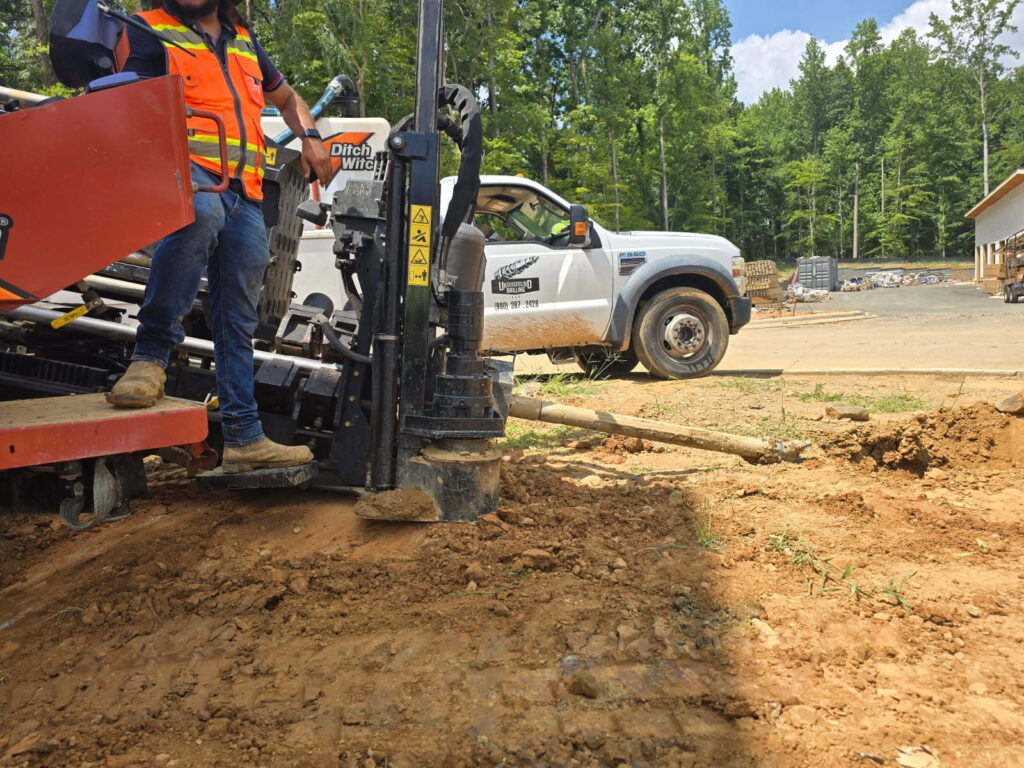

Drive down US-74 through Monroe on a Monday morning and you might see a small crew, a drill rig, and a mud pit at the shoulder and nothing else. By Wednesday, a utility line has been installed beneath a six-lane highway without a single lane closure, a single saw cut in the pavement, or a single complaint from a commuter. That is underground drilling specifically, horizontal directional drilling (HDD) and it is what Underground Drilling LLC has done in Union County and across the Charlotte region for over 25 years.
Underground drilling is the process of installing pipes, conduit, and cables beneath the surface along a precisely steered path — without open-cut excavation. It goes by several names: horizontal directional drilling, HDD, directional boring, horizontal boring,and trenchless technology. These terms are often used interchangeably, though they carry slightly different technical meanings we will explain below.
If you are a project manager, a developer, a municipal engineer, or a property owner trying to understand what underground drilling is, how it works, and whether it is the right method for your project, this guide covers what you need to know written by people who drill for a living in Union County, NC.
Understanding Underground Drilling: HDD, Horizontal Boring, and Trenchless Technology
Underground drilling is the broad term for installing utilities below the surface without disturbing the ground above. Within that category, three terms come up most often:
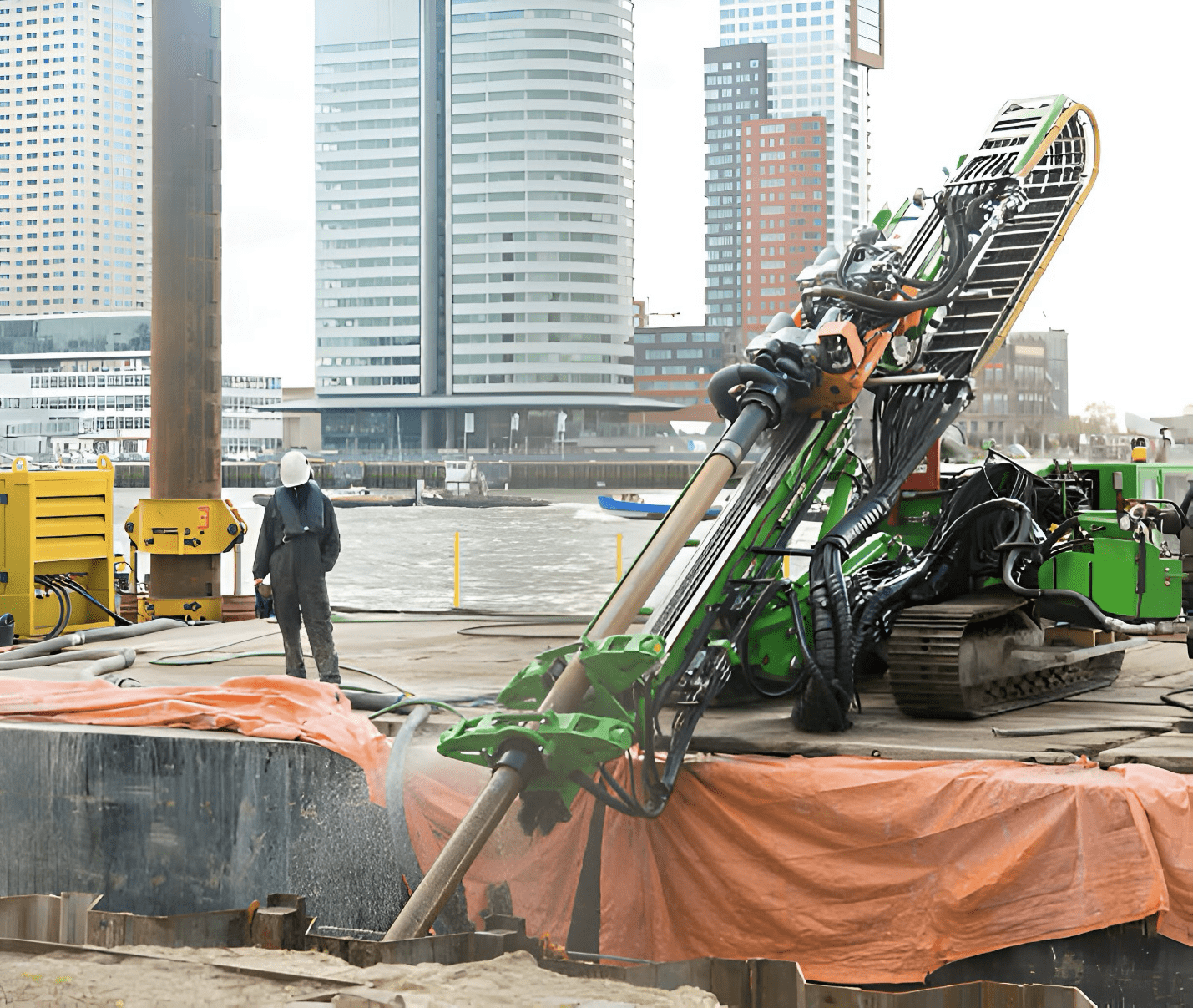
- Horizontal Directional Drilling (HDD) is a steerable trenchless method that uses a rotating drill bit guided along a planned underground path. The drill operator tracks the bit in real time and can steer it to avoid existing utilities, follow road grades, and navigate curves. HDD is the most precise and flexible form of underground drilling and the method we use for the majority of commercial and municipal projects in Union County.
- Horizontal Boring refers to the general act of boring in a horizontal direction underground a slightly older term that is often used interchangeably with HDD, particularly for shorter, straighter bores under driveways, sidewalks, and local roads.
- Trenchless Technology is the umbrella term for all methods of underground construction that do not require open-cut excavation including HDD, pipe bursting, pipe lining, microtunneling, and auger boring. HDD is the most widely used trenchless method for new utility installation.
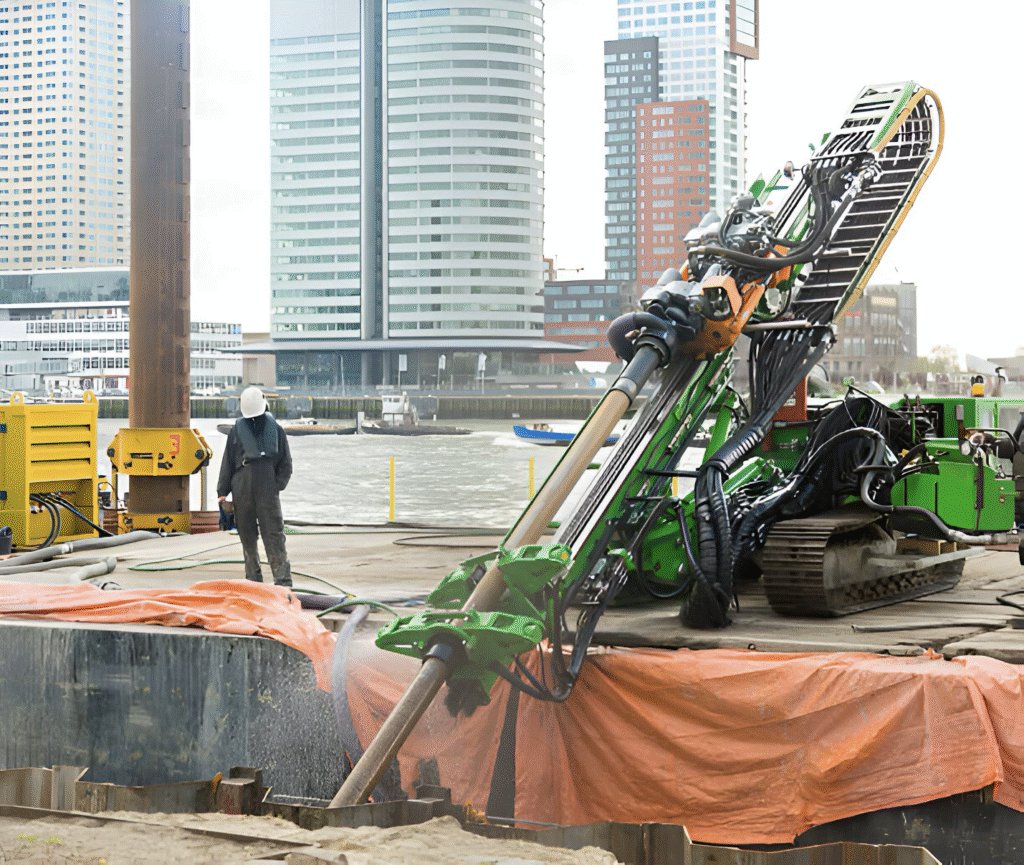
In Union County, where rapid commercial and residential growth along corridors like US-74, Matthews Township Parkway, and NC-200 has created dense above- and below-ground infrastructure, trenchless methods have become the default approach for road and utility crossings not the exception. Open-cut trenching across an active road or through an established commercial district creates disruption and liability that most project owners want to avoid entirely.
The Underground Drilling Process: How HDD Works Step by Step
HDD is a three-phase process. Each phase builds on the last, and the quality of execution at each step determines the success of the finished installation. Here is how it works:
Phase 1: Pilot Bore
The HDD machine is set up at the entry point typically in a small staging area off the side of the road or in an open area near the installation zone. A steerable drill head is pushed into the ground at a shallow entry angle and guided underground along the designed bore path. The operator tracks the drill head in real time using a walkover or wire-line guidance system, adjusting direction as needed to stay on grade and on line. Drilling fluid a mixture of bentonite clay and water is pumped through the drill string continuously to lubricate the bore, stabilize the hole walls, and carry cuttings back to the surface.
In Union County’s Piedmont geology where surface clay gives way to weathered rock and eventually to hard granite and gneiss the pilot bore is where an experienced operator earns their value. We have drilled pilot bores through soft alluvial soils along creek crossings, through dense Cecil clay in established neighborhoods, and through crystalline bedrock in areas of Monroe and Waxhaw where depth to rock is shallow and unpredictable. Local knowledge of what is underground before the drill startsis what keeps bores on grade and on schedule.
Phase 2: Pre-Reaming
Once the pilot bore exits at the designed exit point, the drill bit is removed and replaced with a back reamer. The reamer is pulled back through the pilot bore while rotating, progressively enlarging the borehole to a diameter 25 to 50 percent larger than the product pipe being installed. In hard soil or rock, this may require multiple passes with increasing reamer sizes. Drilling fluid continues to flow during reaming to stabilize the hole and lubricate the reamer.
The size of the reamer and the number of passes required are determined by the product pipe diameter and the soil conditions encountered during the pilot bore. A 6-inch water main requires a different reaming program than a 2-inch conduit bundle. Getting this right is what prevents borehole collapse during pullback a failure mode that turns a one-day installation into a multi-day recovery operation.
Phase 3: Product Pipe Pullback
With the borehole prepared, the product pipe HDPE, PVC, steel, or conduit is assembled on the exit side and connected to the reamer via a swivel. The drill string is retracted, pulling the pipe back through the borehole in a single continuous operation. The swivel prevents rotation of the pipe during pullback, protecting it from torsional stress. Once the pipe is in place, entry and exit points are cleaned up, connections are made, and the installation is complete.
What Underground Drilling Is Used For
Installing Critical Utilities with HDD
Whenever you turned on a tap, powered a phone or logged onto the internet, chances are good that underground drilling made its contribution. Typical applications of directional drilling are made to install:
Water Lines and Sewer Systems
Municipal water and sewer extensions are among the most common HDD applications in Union County. As the county grows particularly in Indian Trail, Stallings, Waxhaw, and the areas around Weddington water and sewer infrastructure is extending into previously unserved areas. Many of these extensions require crossings under state-maintained roads, where NCDOT encroachment agreements require trenchless installation. We have bored water mains and sewer lines under NC-51, Matthews Township Parkway, US-74, and dozens of secondary roads throughout Union County without cutting a single lane of traffic.
Road, Railroad, and Creek Crossings
Crossings under active roads, railroad right-of-ways, and waterways are where HDD is not just the preferred method it is often the only practical one. We have drilled beneath active four-lane highways in Monroe while traffic moved above us, under CSX railroad crossings in Union County, and across creek and stream corridors where open-cut excavation would have required environmental permits and riparian buffer impact analysis. Crossings under Richardson Creek, Sixmile Creek, and McMullen Creek tributaries throughout the county are straightforward HDD work that would be complex, expensive, and slow with any other method.
Advantages of Underground Drilling Over Traditional Trenching
Less Surface Disruption
After 25 years of drilling in Union County, we have seen both methods fail and succeed on the right and wrong jobs. Here is an honest comparison — not a sales pitch for HDD on every project, but a clear breakdown of where underground drilling wins and why.
Faster Project Completion
The directional drilling is usually quicker as compared to trenching. Why? The preparation is smaller, no monumental digging is required and there are fewer weather and surface-related delays. Things that took weeks before are now completed within few days.
Lower Environmental Impact
Among the unscattered advantages of HDD is that it has a lower environmental impact. It does not need large scale digging; thus, it suits wetlands, parks and nature reserves. This particular method reduces erosion, run-off, and the disturbance to the local wildlife.
Reduced Restoration Costs
Once the trenching has been done, it is the duty of the site to be replenished with the trenching back with repaved roads, re-sodded lawns and reconstructed sidewalks. The expenses accumulate. Most of the above-mentioned problems are avoided by HDD, which greatly reduces the price of repair and cleanup after the installation.
Improved Safety and Accessibility
Conventional trenching leaves open trenches and obstructions, which are not only unsafe to employees but also to the community. Horizontal boring reduces the risks to a bare minimum and thus has a safer working environment. Besides, roads and sidewalks remain open during the project.
Ideal Use Cases & Challenging Terrains
Urban Infrastructure Solutions
Contemporary cities are a maze of streets, infrastructure, structures and human beings. Provision of new lines in this landscape without closing major junctions is difficult unless there is an underground drilling. It is made to fit in narrow places and through dense underground areas.
Navigating Wetlands, Rivers, and Sensitive Areas
Digging in a wetland or a forest under protection is not an option. That is where directional drilling excels. Underground installation of utilities can be done by digging below the ground surface so that it does not destroy the aesthetic nature and ecological stability of the region.
Overcoming Barriers with Advanced Navigation Techniques
The modern HDD rigs have GPS, sonar and other tracking devices to make their way through the rock, clay and rugged terrain. This also qualifies them to be used in mountainous regions, locales with a complicated geology, and other such difficult terrains where trenching is not the solution.
Common Misconceptions About Underground Drilling
Despite its rising popularity, the underground drilling is usually not understood. Let’s put a pin in a few of the biggest myths surrounding this marvel of modern technology.
It’s Not Just for Large-Scale Projects
Most individuals believe that directional drilling is applicable in huge infrastructure projects. Consider: great highway, bridges, or multi-city pipelines. But here is the reality, it is just as applicable to smaller jobs such as residential sewer line construction, commercial fiber line or local water connection.
With the development of technology, HDD rigs are now availed in different sizes with the compact rigs fitting in congested areas and the more elaborate path fitting in the larger rigs. That is why even local governments or small businesses as well as certain home-owners may access this effective approach. It is no longer a game reserved only to the big players.
It’s Not Always More Expensive
Horizontally boring may appear more expensive than conventional trenching at first. This makes sense, as it is run by sophisticated equipment and it needs well trained employees. When you consider the overall cost of the whole project which entails the restoration costs, surface-disruption permits and the cost of delaying the project HDD sometimes prevails.
Taking, as an example, opening a city street to lay pipe does not merely need labor and materials, but also repaving, and rerouting traffic, plus inspection. With trenchless option, you eliminate most of those headaches and costs. The initial investment in the long term proves to be a big payoff.
HDD Projects Offer Long-Term Durability
It has the myth that HDD is not as durable when conducting underground installations. These systems are designed in fact to be durable. Materials found in pipes and conduits employed in underground drilling jobs normally include high-density polyethylene (HDPE), stainless steel or reinforced PVC, which are materials that stand pressure, moisture, and movement of the soil.
In addition, the installation itself stirs up as minimum stress on the product. As the pipe is not forced into the ground through rocky or calamitous ground, there is less risk of getting damaged or weakened. It goes more smoothly-and reliably.
Conclusion
Underground drilling, sometimes referred to as directional drilling, horizontal boring or trenchless technology, is a paradigm-shifter in the utility installation industry. Whether it is through water lines and gas mains or fiber optic cable and sewer lines, this new approach is changing the way we think about infrastructure and particularly, infrastructure built in areas where there is limited space or environmental concerns.
Relatively, it has shorter timescales compared to the conventional trenching, has fewer negative effects on the environment, is safer, and has substantial long-term cost advantages. It is not only applicable in large-sized jobs. HDD precision and efficiency is applicable even in providing services to small communities and business ventures with the right technique.
With population increasing in urban surroundings and the need to have a good infrastructure that can be depended upon, underground drilling is one such intelligent decision that can be of use. Be it a local government interested in plotting out the next public works project or a contractor seeking a more efficient means of installation that provided a safer environment then it is time to look into the possibilities of HDD.
Underground Drilling LLC is a reliable source of information about the trenchless industry where you can read more or start with your next project.
Frequently Ask Questions
What is the difference between underground drilling and trenching?
Underground drilling specifically HDD installs utilities along a subsurface bore path without disturbing the surface above. Trenching requires open excavation for the full length of the installation. In developed or paved areas, underground drilling is generally faster, less disruptive, and often lower total cost when pavement restoration is factored in. In open, undeveloped terrain, trenching may be more straightforward and economical. The right choice depends on the site conditions, the surface above, and what is already buried in the path.
Is directional drilling safe for residential areas?
Yes — when done correctly. HDD is inherently safer near existing utilities than mechanical excavation because it eliminates the backhoe bucket or trenching chain that can strike a buried line. The critical safety step is verifying what is underground before the drill starts — not relying on 811 records alone. Underground Drilling LLC uses private utility locating (GPR and electromagnetic detection) and hydrovac potholing to confirm utility depths at every critical crossing before any bore begins. That pre-bore process is what makes HDD genuinely safe near existing infrastructure.
How long do HDD installations last?
HDPE pipe the most common product pipe for HDD installations is rated for a 50-year or greater service life under normal operating conditions. PVC and steel pipe installations have comparable or longer rated service lives. The HDD installation process is controlled and non-impactful: the pipe is pulled through a lubricated, properly sized borehole rather than forced or hammered through the ground, which minimizes installation stress and protects the pipe’s structural integrity for the long term.
What are the risks of using horizontal boring?
The primary technical risks in HDD are inadvertent returns (drilling fluid surfacing in an unintended location), borehole collapse during reaming or pullback, and utility strikes if pre-bore locating is incomplete. These risks are managed through proper bore path design, drilling fluid formulation matched to soil conditions, pre-reaming the borehole to the right size before pullback, and most importantly thorough private utility locating before the drill enters the ground. An experienced crew with proper equipment and a disciplined pre-bore process manages these risks to an acceptable level on the vast majority of projects.
Can HDD be used under roads, highways, and railroad tracks?
Yes road and railroad crossings are among the most common HDD applications. We have bored under state-maintained highways, county roads, and CSX railroad crossings throughout Union County. Crossings under NCDOT-maintained roads require an encroachment agreement from the appropriate NCDOT Division office (Division 10 for Union County) before work begins. We have experience with the Division 10 encroachment process and can advise project teams on documentation requirements. Railroad crossings require separate agreements with the railroad operator and typically involve casing pipe requirements and depth minimums that we incorporate into bore path design.
What size pipes can underground drilling install?
Underground Drilling LLC installs pipe from 2 inches to 24 inches in diameter via HDD, including HDPE, PVC, and steel pipe as well as conduit bundles. The pipe size that can be installed is a function of the bore diameter achieved during reaming, which in turn depends on soil conditions, bore length, and machine capacity. We match the bore program to the product pipe size and site conditions during project planning there is no guesswork on this in the field.
How much does underground drilling cost in Union County, NC?
HDD project cost depends on bore length, pipe diameter, soil and rock conditions, number of crossings, and access constraints. Simple residential or light commercial bores start in the range of $1,500 to $5,000. Municipal and commercial road crossings typically run $5,000 to $30,000+ depending on diameter, length, and site complexity. We provide free project-specific estimates for all Union County and Charlotte metro projects contact us with your project details and we will give you a straight number.