
Picture this: You’re an estimator for a general contractor in Union County, and you’ve just won a bid for a commercial site job. The scope includes running a new 8-inch water line under a busy four-lane highway. Your first instinct might be open-cut—trench, lay pipe, fill, repeat. But then the reality sets in. You’re looking at a week of lane closures, negotiating with the NCDOT for a permit that takes months, and restoring asphalt that hasn’t been touched since the 90s. The cost bleeds into five figures before you even turn a shovel of dirt.
Now, imagine this: A horizontal directional drilling (HDD) crew shows up. They set up on one side of the road, the drill head appears on the other side by lunch, and by the end of the day, the pipe is pulled back and the job is done. The road never closed. The asphalt never cracked. That’s the reality most estimators don’t price in until they’ve been burned by the old way of doing things. For contractors working in the Charlotte metro and beyond, understanding when and how to use HDD isn’t just a technical detail it’s a competitive advantage.
What Is HDD and When Does It Make Sense in NC?
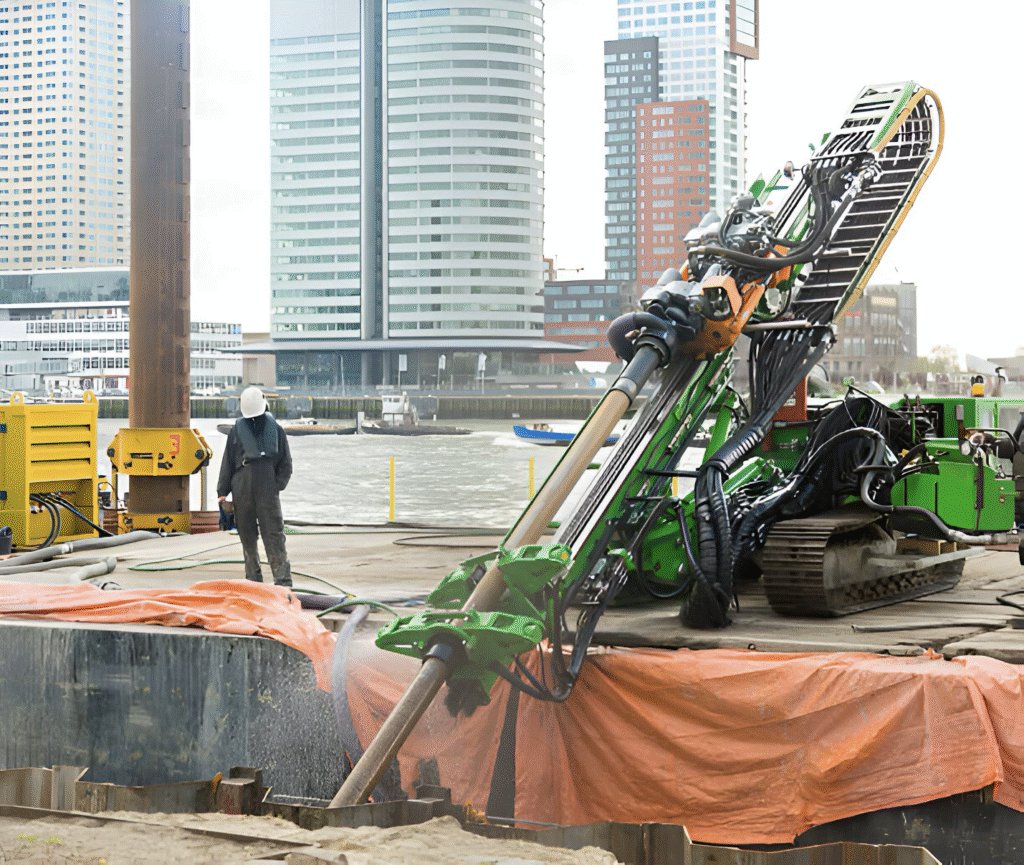
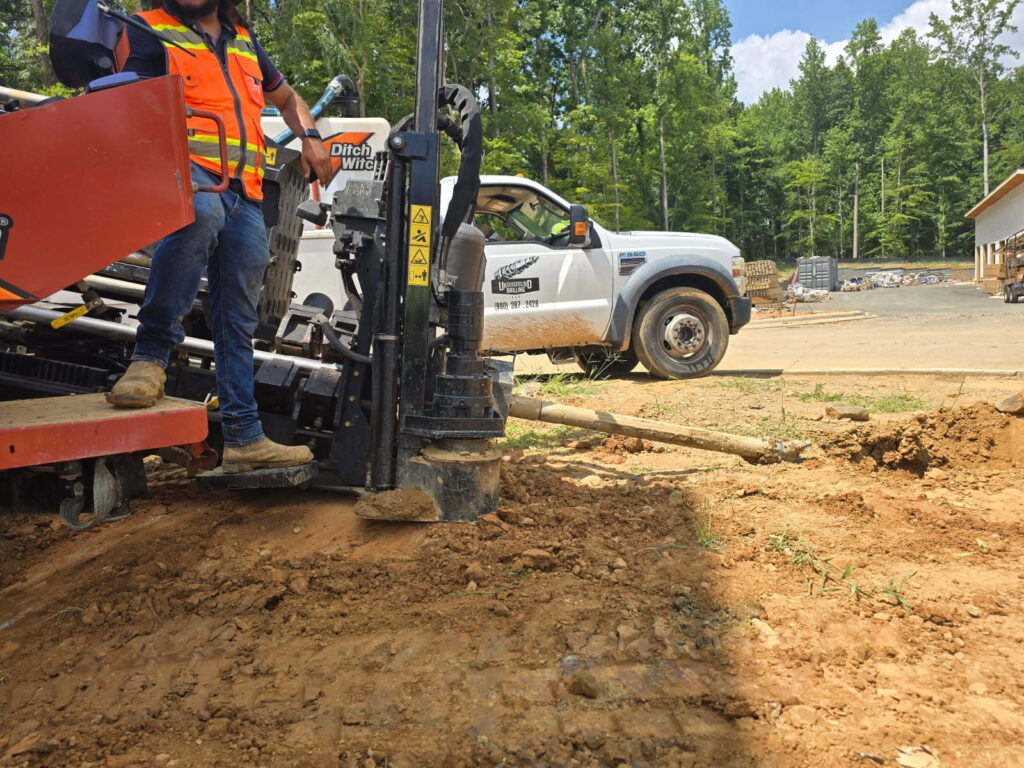
In the simplest terms, Horizontal Directional Drilling is a steerable, trenchless method of installing underground utilities. Instead of digging a ditch, we launch a small drill head from the surface. It bores a pilot hole along a predetermined path, we enlarge that hole to the right size (a process called reaming), and then we pull the pipe back through. It’s minimally invasive, highly precise, and incredibly fast.
But just because you can use HDD doesn’t mean you always should. In North Carolina, there are specific scenarios where it’s not just the best option—it’s the only practical one. You need HDD when:
- Crossing under NCDOT right-of-way: Trenching through a state-maintained road is a regulatory headache. HDD avoids disrupting the road surface and traffic flow.
- Working in developed neighborhoods: In places like Matthews or Ballantyne, tearing up a homeowner’s landscaping or a newly paved driveway is a non-starter. HDD preserves the surface.
- Navigating environmental features: When you need to get a fiber line or gas line under a creek, a protected wetland, or a drainage ditch, HDD eliminates the need for dewatering and environmental mitigation.
- Dealing with deep installations: If your utility needs to be 15 or 20 feet deep, open-cut becomes a massive excavation project. HDD makes deep bores routine.
While auger boring is good for straight, cased crossings and trenching works in open fields, HDD is the only method that combines steerability with speed in sensitive or developed areas.
NC Soil Conditions & How They Affect Your Project
If you’ve worked in the Charlotte region for any length of time, you know the dirt doesn’t play nice. This isn’t the sandy loam of the coast. The Piedmont presents a unique geological cocktail that can turn a simple bore into a costly headache if you aren’t prepared.
The first challenge is the heavy red clay. It’s sticky, it’s dense, and it loves to bind to drill tooling. In clay-heavy environments, drilling fluid (bentonite) usage skyrockets because you need the lubrication to prevent the clay from balling up on the reamer. This usually means more reaming passes to clean the hole, which adds time to the project.
The second challenge is the “transition zone.” North Carolina geology is notoriously layered. You might start drilling in soft soil, hit a layer of weathered rock (saprolite), and then slam into solid granite—all within a 50-foot bore. If your driller doesn’t have the experience to feel that transition in the torque readings and adjust the tooling or pressure on the fly, you risk stalling the bore or, worse, splitting the pipe during pullback.
Finally, rock near the Charlotte metro is a given. Much of the area sits on granite and gneiss. Drilling through rock requires specialized mud motors or rock bits, and it slows production significantly. This is why a geotechnical assessment isn’t an optional expense—it’s the difference between a budget you can trust and a budget that blows up the moment the bit hits bedrock.
HDD Cost Breakdown for NC Contractors
So, what does this actually cost? This is the gap all the competitors miss. While every site is unique, here are realistic, ballpark figures for the Charlotte region to help you budget your next project:
| Project Type | Typical Bore Length | Pipe Diameter | Estimated Cost Range | Notes |
| Residential Fiber Crossing | 50 – 150 ft | 2″ – 4″ | $1,500 – $4,000 | Simple shot under a driveway or street. Minimal setup. |
| Commercial Water Line | 200 – 400 ft | 6″ – 12″ | $8,000 – $20,000 | Includes larger reamers, more fluid, and traffic control. |
| NCDOT Road Bore | 300 – 600 ft | 12″ – 24″ | $25,000 – $60,000+ | High liability, NCDOT inspection, casing required, complex entry/exit pits. |
| Utility Distribution (Rock) | 100 – 300 ft | 4″ – 8″ | $15,000 – $40,000 | Rock drilling adds significant cost due to tooling wear and slow progress. |
These are ballpark ranges. Every NC project quotes differently based on bore path, soil report, pipe diameter, and whether you need traffic control or NCDOT coordination. The only way to get an accurate number is a site assessment.
The 3-Stage HDD Process: What to Expect on Your Job Site
Knowing the process helps you manage your schedule and your subs. Here is the contractor-level breakdown of what happens on your site.
Stage 1: Pilot Bore
This is the setup. We position the drill rig, stake down the entry point, and begin drilling a small-diameter hole (usually 3-4 inches) along the designed path. A locating system—like a walkover locator or a wireline tracking system—tracks the head’s position, depth, and pitch in real time. This is where precision matters most. If the pilot hole is off by a foot at the entry, it could be off by ten feet at the exit.
Stage 2: Reaming
Once the drill head exits the ground on the far side, we attach a reamer—a larger barrel-shaped tool—and pull it back through the hole. This expands the bore path to the final diameter needed for your pipe. In NC clay, we may need to do this in multiple passes (pre-reaming) to keep the hole stable and clear of cuttings. When we hit those clay-to-rock transitions, we slow down to ensure the hole stays uniform.
Stage 3: Pullback
The final step. We attach the product pipe (usually HDPE, fused together for a continuous length) to the swivel on the reamer and pull it back through the freshly drilled hole. The type of product matters: HDPE is flexible and great for HDD, while rigid PVC or steel conduit requires careful handling to avoid stress points. For a standard commercial utility crossing in the Piedmont, you’re looking at a timeline of one to three days from mobilization to cleanup.
NCDOT, Permits & Right-of-Way in NC
You cannot drill under a road in North Carolina without a permit. Period. This is a step where GCs often get tripped up, assuming their excavation sub has it covered.
Any boring under a state-maintained road requires an NCDOT encroachment permit. The application process takes time and requires detailed plans. Furthermore, if the job is a public NCDOT project, your HDD subcontractor must be an NCDOT Prime Contractor or an approved sub-contractor—verify this before you bid.
Beyond the state, remember that NC 811 must be called before ANY bore. This is state law, not a suggestion. Hitting a live gas line or a fiber trunk because you skipped the locate is a career-ending mistake.
Also, don’t assume municipal right-of-way (ROW) permits are standardized. A bore in Union County might have a simple approval process, while a bore in Mecklenburg County could involve a half-dozen different municipal utility authorities. Know your jurisdiction.
Choosing an HDD Contractor in NC: What to Ask
Hiring an HDD crew is a partnership. You’re trusting them with the most delicate part of the underground scope. Here’s a checklist of questions to ask when vetting subs for your next Charlotte-area project:
- Are you NCDOT-approved for public ROW work? If the job touches a state road, the answer needs to be yes.
- What local soil conditions have you drilled in? Ask for references specifically for projects in the Piedmont. A driller who only works in the coastal plain won’t know how to handle our clay and rock.
- What’s your contingency for encountering rock? Their answer should include specific tooling (rock bits, mud motors) and how it impacts the budget.
- What’s included in your quote? Is mobilization a line item or included? Who handles fluid disposal and site restoration? Ambiguity here leads to change orders.
Underground Drilling has completed projects across Union County and the Charlotte metro, navigating the red clay and granite that stop other crews. We understand the local permitting landscape and the geology beneath it.
Conclusion
Horizontal directional drilling is the right tool for a specific set of jobs in North Carolina: road crossings, environmental areas, and developed sites where surface disruption is unacceptable. But the method alone isn’t the solution—it’s the execution. Soil conditions, permit compliance, and contractor experience are what make or break the outcome.
If you have a project coming up that requires precision underground work, don’t leave it to chance. Contact Underground Drilling today for a site assessment and a firm quote. Let’s get your next bore done right, the first time.